

Clogged Suburb Reaches Tipping Point: What a Leaning Crane Revealed About Carlingford
By Alan Mascarenhas
Last month, on a Friday afternoon, I caught the light rail to Carlingford and walked up Pennant Hills Road. A far cry from the “bad old days” when it could take two hours to drive to Hornsby, the usual sea of cars was missing. The jampacked thoroughfare was silent. Not from an apocalypse or a lockdown, but from an emergency.
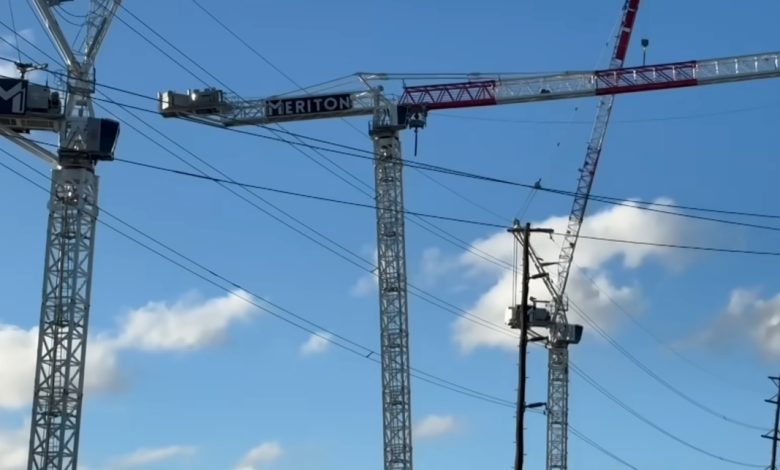
A crane – part of Meriton’s ambitious 1,200-home development – had begun to tilt in wild winds, casting a shadow not just physically, but symbolically, over the state of planning in the area.
Dubbed the “leaning tower of Carlingford,” the incident triggered evacuations, shut down a major arterial road, and disrupted thousands of lives for days. Bunnings was forced to close, along with nearby restaurants like Taste of Tuscany. Families scrambled to reroute school drop-offs. Tradies and delivery drivers were stranded. A five-minute errand became a 45-minute detour.
Thankfully, no one was hurt. Emergency services, agencies and local residents stepped up. But the chaos exposed something deeper: how brittle and underprepared our local infrastructure really is – and how little room for error exists in a suburb that’s grown rapidly.
Pennant Hills Road is one of Sydney’s oldest and busiest corridors. Carlingford sits right at its heart. Yet for all the townhouses, duplexes and high-rises now dotting the skyline, the infrastructure beneath and around them hasn’t kept pace.
The light rail ends prematurely, falling short of Carlingford Court and Epping. School catchments are stretched, and the nearest hospital is miles away. Traffic remains a daily frustration, riddled with choke points and glaring safety issues. The Evans Road intersection – still without traffic lights – isn’t just an accident waiting to happen. Accidents are already happening.
Having grown up in the area since the late 1980s, I’ve watched Carlingford evolve. Over the years, it has sat betwixt and between three councils – The Hills, Parramatta and Hornsby – and until recently, was split across multiple state and federal electorates. The inevitable result? Blurred responsibility and fragmented planning.
With more development coming – much of it welcomed amid a housing crisis – we need to ensure that growth is matched by investment in the essentials: safe roads, reliable public transport, quality schools, accessible healthcare, community facilities, green public spaces and trees.
Carlingford is well-positioned for that kind of future. It sits strategically between major employment hubs like Parramatta, Macquarie Park and Norwest. The Meriton development offers more than just housing. It’s a rare chance to shape a walkable, vibrant town centre between the new light rail station and Carlingford Court, giving the suburb new heart and identity.
But potential means little without follow-through. The crane incident highlighted a fundamental failure in crisis communication. For the most part, residents had to crowdsource updates through Reddit and Facebook. Days later, the company’s website offered only a vague statement suggesting people could “feel free” to lodge claims for “reasonable” costs. But what’s reasonable? Who decides? And how are small businesses or residents with limited English meant to navigate this process?
All concerned should treat this not as a one-off, but a chance to do better. Improving coordination not just during emergencies, but long before. That means embedding risk management into every major project, defining clear lines of responsibility, and delivering smarter, joined-up planning.
Carlingford is changing. More professionals, students and young families are moving in – many from diverse, multilingual backgrounds. They deserve safer roads, better services, and infrastructure that matches the promise of the place they’ve chosen to call home.
The crane has been stabilised. But the real challenge is whether a tipping crane can become a tipping point for the area itself.
Carlingford isn’t on the edge of Sydney anymore. It could be at the centre of its future. Let’s start treating it that way.
Alan Mascarenhas is a former journalist, political speechwriter and state Labor candidate for Epping. He works for Business Western Sydney.