


The Hills Shire is one of Sydney’s fastest-growing regions. New housing in Box Hill and North Kellyville, expanding employment in Norwest, and increasing commuter flows along Windsor Road and Old Northern Road reflect economic strength.
But alongside this growth, there is a troubling pattern: fatal and serious injury crashes are rising.
Statewide and locally, the data suggests a shift not necessarily in total crash numbers — but in severity.
Statewide trend: a concerning increase

Figure 1: NSW road fatality dashboard showing 2026 year-to-date fatalities compared to the same period last year, and the rolling 12-month total compared to the previous 12 months.
The data shown in Figure 1 indicates:
- 2026 year-to-date fatalities exceed the same period last year.
- A rolling 12-month total higher than the previous 12-month period.
This confirms that the upward movement is not seasonal noise — it reflects a structural shift in severity outcomes across NSW.
The Hills does not exist in isolation from this trend.
Local picture: The Hills crash distribution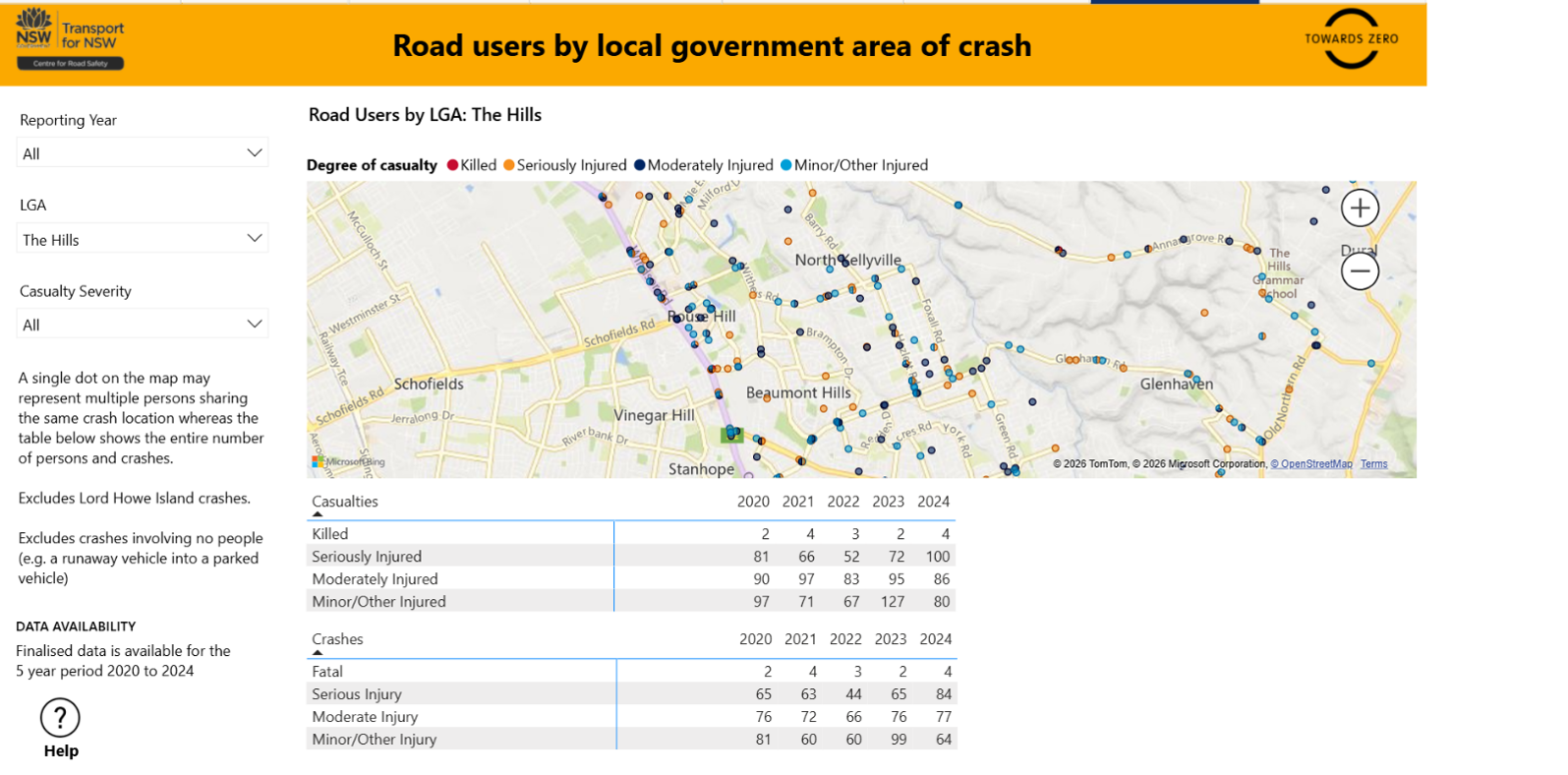
Figure 2: Crash distribution and casualty severity in The Hills LGA (2020–2024), showing fatal, serious, moderate and minor injury outcomes.
Figure 2 illustrates:
- Spatial clustering of crashes along arterial corridors.
- Persistent serious injury occurrences across multiple years.
- Variability in minor injuries, but a concerning trend in serious outcomes post-2022.
While fatal crashes remain relatively low in absolute numbers (as expected in a single LGA), serious injury crashes have shown upward movement in recent years.
This is the key issue.
Serious injuries are life-altering events — spinal trauma, traumatic brain injury, long-term disability.
They are the true measure of whether the system is protecting people.
The role of Towards Zero
Transport for NSW operates under the Towards Zero strategy — a Safe System framework designed to eliminate deaths and serious injuries.
The model is built on four principles:
- Safe speeds
- Safe roads
- Safe vehicles
- Safe people
NSW has invested heavily in median barriers, blackspot programs, mobile phone detection cameras and speed enforcement.
So why are fatalities and serious injuries increasing?
The answer is multifactorial.
- Population growth and exposure
The Hills is among Sydney’s fastest-growing LGAs.
More residents mean:
- More vehicles per household
- More vehicle kilometres travelled
- Increased heavy vehicle activity
- Higher intersection demand
Road safety research consistently shows a direct relationship between exposure (vehicle kilometres travelled) and crash frequency.
As travel volumes rebound strongly post-pandemic, severity outcomes have increased more sharply than minor crash numbers.
Infrastructure often lags population growth by several years.
- Speed: the exponential risk factor
Speed remains the most powerful severity multiplier.
Australian road safety research demonstrates that:
- A 5% increase in average speed can increase fatal crash risk by over 20%.
- Pedestrian survival probability drops sharply above 50 km/h.
The Hills contains:
- Wide arterial roads
- Semi-rural connectors
- Long straight sections
Even modest “speed drift” above posted limits significantly increases crash severity.
The issue is not extreme speeding alone — it is everyday compliance slipping by 5–10 km/h.
- Mobile phones and cognitive distraction
Research from Australian institutions including Monash University’s Accident Research Centre shows:
- Handheld phone use increases crash risk approximately fourfold.
- Hands-free conversations still impair cognitive processing.
- Visual distraction exceeding two seconds dramatically increases crash likelihood.
The behavioural environment of 2026 is fundamentally different from 2015.
Drivers now operate in an always-connected environment:
- GPS navigation is constantly active.
- Message notifications.
- Work emails read at traffic lights.
- Social media interaction in congestion.
Even with enforcement, cognitive distraction remains embedded in modern driving behaviour.
The road system was not designed for divided attention at this scale.
- Post-COVID behavioural recalibration
Multiple Australian studies have noted:
- Increased aggression
- Higher average speeds
- Greater impatience
- Risk-taking behaviours
During lockdown periods, traffic volumes dropped. Drivers adapted to emptier roads. When congestion returned, behavioural recalibration lagged.
This behavioural inertia is contributing to severity outcomes.
- Vehicle mass and injury outcomes
SUV and dual-cab ute ownership has increased substantially. Heavier vehicles generate greater kinetic energy in crashes. Even if crash frequency remains stable, injury severity can increase due to:
- Vehicle mass
- Front-end height relative to pedestrians
- Rollover dynamics
Fleet composition matters.
Is Towards Zero failing?
No.
But the system is under strain.
Towards Zero assumes:
- Speed compliance remains stable.
- Infrastructure upgrades keep pace with growth.
- Behaviour adapts alongside enforcement.
In fast-growing areas like The Hills, exposure and behavioural complexity are evolving rapidly.
Without continual recalibration of speed environments, infrastructure retrofits and behaviour management, severity will rise.
What needs to happen locally?
The data in Figures 1 and 2 suggest:
- Corridor-level speed environment reviews.
- Safe System audits in growth precincts.
- Increased protected turn treatments and median separation.
- Raised intersection design in local centres.
- Continued enforcement paired with behavioural education around distraction.
Road safety must scale with urban growth. Fatalities and serious injuries are rarely caused by a single factor.
They emerge from the interaction of:
- Population growth
- Speed compliance drift
- Digital distraction
- Larger vehicles
- Rapid suburban expansion
The Hills remains one of Sydney’s most liveable regions. But liveability must include safety.
Growth without recalibrated safety systems will continue to pressure the Towards Zero vision.
The goal of zero is not unrealistic. But it requires continuous adaptation.
www.trafficengineers.sydney is a NSW-based traffic engineering consultancy specialising in road safety audits, traffic impact assessments.